Knowledge and Technological Innovation
How Do We Know Something?
At a previous job interview, I was presenting research from my postdoctoral tenure to three scientists. The atmosphere was heightened and adversarial, I suspect by design. Every claim I asserted was thoroughly scrutinized. I presented a method that detected bacteria undergoing division, and a deluge of challenges and questions immediately followed: “How do you know your measurement corresponded to the number of bacteria?” “How did you develop the method?” “How do you know this particular method corresponds to another more validated method?” I fully and directly answered the incisive queries of my data and methodology; however, a skeptical miasma still suffused the room. In the penultimate slide, I presented an explanatory mechanism that tied all of the data together and predicted when bacteria divided. To substantiate the mechanism, I presented two follow-up experiments to change the division timing, derived from the model presented. One of the attendant scientists rebuked me, asking: ”Are two experiments enough to prove this model?” I verbally invoked a few more experiments that we tested and passed against our model. He then reiterated, “Are five to six experiments enough?”
How do we prove something? This question has occupied humanity’s thinking for most of our recorded history. Aristotle differentiates true versus false in his treatise entitled Metaphysics, dating back from around 330 BCE. Stated another way, how do we generate knowledge? In the more formal terminology, we’re asking how scientific epistemology works. We need new knowledge to make technological advancement; in the case at hand, to move beyond animal products. Research and development is how we’ll fully move on.
Ask an ostensibly full-time knowledge generator/promulgator (e.g., a scientist or an academic) this question, and I sincerely doubt they could confidently provide an answer as evinced in the aforementioned story. In my education, the most that I learned about the knowledge-generation process came when I was in elementary school. We discussed the scientific method incessantly:
- Question or problem: What are we trying to answer? What is the problem that we are trying to solve? We build from previous knowledge here.
- Hypothesis: This is some conjecture that we make about the problem or question. It is something to be tested with an experiment.
- Experiment: We perform some procedure or measurement used to prove or disprove the hypothesis.
- Analysis: Here, we examine our data to see if our hypothesis was proven or disproven.
These instructions were thoroughly inculcated in me, particularly as manifested in the three different years I implemented them for school science fairs, so much so that I still remember them twenty years later. I remember designing my graduate research projects based on this same model, where I articulated the question, hypothesis, etc. Only within the last few years did I learn the formal name for this system of inquiry—inductivism. Inductivism implies that there are foundational knowledges, absolute truths, which we can build on and add to. The questions and observations must be anchored to underlying, validated knowledge. I imagine a brick house where scientists, or knowledge-generators, make the bricks. The bricks are then inspected by other reviewing scientists to ensure congruence. Very often, these reviewing scientists will return a brick to the originating scientists to refine it more. Only after the brick has been refined enough will it be added to the structure. The reviewing scientists consider each brick carefully; no spurious bricks can be added lest the entire knowledge structure buckle.
The most widely accepted knowledge model is seemingly inductivism, especially in the biological sciences. If it’s not obvious, I allegorize the brick house to scientific publishing. And we might therefore automatically attribute perfect function to inductivism, if it’s the underpinning to scientific publishing. But consider the following points:
If a scientist seeks to publish a study in a top journal, he or she first must entice a fickle editorial staff. If the study isn’t within the scope of a currently hot topic or authored by a well-connected scientist, then the submitting scientist is rolling the dice. If the editorial staff accepts the study for publication, they’ll send the submission out for peer review and solicit other scientists’ views in order to gauge its impact and scientific rigor. There are, however, no defined criteria for scientific rigor, leaving such judgments to the whim of every reviewing scientist.
So, if the submitting scientists are lucky, the reviewing scientists will have no conflicts of interest and want to believe in the conclusions of the study. A friend once joked that publishing in a top journal requires a study that asserts something that the reviewing community has always believed in but for which has just lacked the evidence. Even if all of those parameters are satisfied, it is not uncommon for the editor and reviewers to ask for additional experiments and analysis, which sometimes may take years.
Defense of the current publication system often rests on a couple of fallacious arguments. One refrain is that pre-publication review makes a paper better.1 Well, sure. If it didn’t do at least that, then we would have zero reasons to maintain the process. The real question is whether it justifies the opportunity cost. For instance, one of my friends presented a project to me back in 2015. At that point, the key findings of the project were profound and backed up by strong experimental evidence. For career reasons, this colleague needed this work to be published in a high-impact journal. He spent years toiling away, polishing it more and more. He submitted it many times to top journals, getting rebuffed in the first year. After revising and timing his submission so that editors would be more receptive, the final submission—to the lofty journal Nature*—*finally gained some traction. Still, he had to spend an additional two years adding marginal experiments to satisfy the picky reviewers. Finally, in 2020, a full five years after he first showed me the project, the paper was published. The published version is certainly improved compared to the initial one that he shared, but is it five years, hundreds of hours, hundreds of thousands of dollars in added cost better? No.
Many problems with scientific publishing are underscored by this story. First, my friend spent an inordinate amount of resources to publish a paper that became, say, only ten to fifteen percent better. And the key findings were roughly the same. He could have instead been pursuing another relevant project, but due to professional incentives, needed a high-impact paper. The second issue about this story is, wouldn’t humanity benefit from accessing these findings sooner? If a “less impactful” form of the paper had been released back in 2015, other scientists could have built on it, learned from it, and used it to advance their own science. This is especially important when the findings may affect something such as human health. If that’s the case, then releasing findings in 2015 versus 2020 could actually save more lives.
Another friend mentioned a paper she wrote in graduate school, which still hadn’t been published five years after submission. Her graduate school advisor, the person sponsoring the research behind the paper, is still trying to add more data to entice a top journal. The findings of this study relate to a protein behind the pathology of Alzheimer’s disease. Isn’t it tragic that humanity does not have access to this knowledge because of the demanding publication process and the career incentives? Talk to any publishing scientist and I’m sure you’ll find stories like these. And unfortunately, we don’t have a systematic way to find these “rotting in the drawer” projects. Proponents for journals may nonetheless argue that we need to make sure that the science is correct before release, but it begs the title question of this section.
So, there are clearly many deficiencies with scientific publishing as far as it is rooted in inductivism. At best, scientific publishing is a suboptimal way to produce knowledge or, in this case, get us to animal product alternatives. Additionally, the brick house analogy fails anyway because papers are often corrected post-publication, or even retracted. Furthermore, inductivism still doesn’t answer the question: how do we know something? But maybe we can consider pieces of it, in particular, the aspect of scientists reviewing other science.
I’ve lost probably months of time in my research career due to inadequate quality control from scientists whose work I am building on. For example, I often worked with DNA sequences established in scientific literature. In more than one instance, I received DNA from other scientists to introduce into my bacteria for the purposes of eliciting specific functions (phenotypes). The scientists would also provide the text sequence of the DNA. The text sequence would explicitly designate whether or not the supplied DNA could impart the desired phenotype. I would introduce the supplied DNA into my bacteria, getting the bacteria to incorporate the outside DNA and impart its putative function. Often, I would not see the expected phenotype. My first inclination was always that I was doing something wrong with the outside DNA. I would spend weeks to months tinkering to ensure the proper conditions for the phenotype. Eventually, I would sequence the DNA myself and find that the sequence provided by the scientist was actually wrong. If I had simply sequenced the DNA first, I would have been spared all the failed efforts. Imagine that I’m trying to produce a non-animal steak from an antecedent scientist’s work, and I get their DNA for the protein fibers. If I don’t get a steak nearly as juicy as theirs, then I have to surmise that the DNA is perhaps aberrant. Confidence in the DNA sequence is essential.
As a result of such bad experiences, I changed how I sourced DNA from outside parties. I would first sequence the DNA myself if it were coming directly from another scientist, or I would rely on organizations that perform their own validation, such as the nonprofit AddGene. Within the AddGene website, I can see the DNA that both the submitting scientist and AddGene have generated. As a test, I bought some DNA through AddGene, and amazingly, it worked exactly as intended on the first test that I performed. Therefore, some sort of review process is indeed helpful and can accelerate our knowledge generation. And as AddGene demonstrates, new technology such as the internet can advance this. “Papers” are not the only unit of knowledge; that’s clearly a vestige of pre-internet days. Our ability to find a new casein protein does not have to rely on scientific publishing.
The Evolutionary Model of Knowledge
There are also other problems with inductivism. The first is that we can never prove that something is absolutely true, no matter how many experiments we perform. Consider the case of boiling water. Suppose I wish to assert that water always boils at 212°F or 100°C. I could perform this experiment a billion times, and it would always be true. But if I ascend a mountain, this result no longer holds, as the water boils at a lower temperature. So immediately, the assertion that water boils at 100°C is rejected by going up the mountain.
Karl Popper, an influential scientific epistemological thinker, recognized this fundamental asymmetry between proving and disproving assertions.2 We can never actually prove something to be true, but we can disprove knowledge readily. Popper also recognized that all knowledge has limits and is provisional. The boiling water example has a clear limit with the elevation, or more precisely with pressure. When we change elevation, then we change the boiling point of water because the environmental pressure changes.
Any knowledge that we generate may be supplanted by better knowledge later on. With boiling water, we now have phase diagrams that tie the phase (vapor, liquid, or solid) to the temperature and pressure.3 Another good example of the progress of knowledge is Newton’s Laws. Anyone who has taken high-school physics has learned concepts such as force equals mass times acceleration, and that physical bodies will confer equal and opposite reactions. However, unless you’ve taken enough physics courses, you may not be privy to that fact that Newton’s Laws have been replaced by superior knowledge—specifically, quantum theory and Einstein’s General and Special Relativity. These theories are much more precise and have much more reach compared to Newton’s Laws. For example, relativity will correctly predict a deflection that occurs as bodies orbit around each other; whereas Newton’s Laws do not predict such phenomena. Newton’s Laws are a special case of relativity, if anything.
All of our conclusions are ultimately temporary, a potentially depressing concept for knowledge generators and promulgators. Two comments to ameliorate such concerns: first, it is likely any generated knowledge will be a stepping stone to better knowledge, which can even fully replace that interim thinking. The superseding knowledge benefited from the pre-existing knowledge. That is something to be proud of. Secondly, knowledge can still be useful even when supplanted by better theories. We still learn and readily apply Newton’s Laws because they provide useful calculations and inform engineering strategies. If I want to build a large bioreactor to produce my non-animal meat, Newton’s Laws allow me to calculate how much power is needed to stir the tank. We understand Newton’s Laws to be a special case of relativity, and we still learn them in school as an entry point into physics. We have not dispensed with Newton’s Laws completely.
Popper’s model for knowledge generation correlates well to the Theory of Evolution (Figure 3). We first develop knowledge through a variety of conjectures (akin to genetic variance) intended to solve a current set of problems. These conjectures are putative and have not been subject to a selection pressure. We reject knowledge that is unfit by applying refutations. The refutations can be arguments that point out the fallacies of the asserted knowledge or can be incongruent experimental results. Refutations are the selection pressure that I discussed in the previous chapter when examining the Theory of Evolution. As we saw earlier, all knowledge has limits. For example, the Theory of Evolution has been one of the sturdiest pieces of knowledge in the biological domain for over 150 years. It explains how, under given selection pressures, biological lifeforms will evolve. Evolution, however, cannot explain how life began in the first place. As of this writing, the inception of life remains a problem/question that vexes scientists. Accordingly, the inception of life remains in the new set of problems after discovery of the Theory of Evolution (in this case, Problemsn+1).

Figure 3. Karl Popper’s model for knowledge/technology generation. The existence of problems inspires conjectures to solve the problems. Through refutations, the fittest conjectures are left. This constitutes a new set of knowledge and technology. With each iteration, we are left with a different set of problems to solve.
In the Theory of Evolution, fitness advantage is determined by whether an organism is fitter than the next best competitor. There is no “absolute” fitness. We cannot claim that elephants are more fit than sea slugs. Elephants would thrive more in dry climates eating leaves and fruit. Sea slugs thrive in aquatic environments eating algae. Both species occupy completely different niches and accordingly cannot be compared. Similarly, no current knowledge is absolute in the Popperian model. Therefore, knowledge cannot be judged absolutely. There is no known bedrock truth—there is nothing to anchor what we know. We can only evaluate a piece of knowledge in relation to the next best competing knowledge in how it solves a given problem.
For example, the Theory of Evolution’s next best competitor may be Lamarckism. For the uninitiated, Lamarckism claims that biological traits are passed to descendants by the performed actions of the parent. Lamarckism supposes that ancestral giraffes had to stretch their necks in order to reach the leaves in the trees. The stretched neck was passed down to descendants, and each consecutive generation stretched more and more. Lamarckism does not require the variance that the Theory of Evolution demands, just a continued action of progenitors that will exaggerate the traits, eventually to the most useful degree.
Popper’s model suggests that we are dramatically replacing our knowledge all of the time. In actuality, instead of wholly replacing a theory, it’s often better to amend it, leaving the revised theory better than the competitors.
Here’s what this can look like in the real world. Recent epigenetic research suggests that there may be something such as a Lamarckian effect within Holocaust survivors.4 Specifically, there are chemical modification (epigenetic) changes to the DNA of Holocaust survivors such that they exhibit more stress stemming from the concentration camp conditions. These phenotypes were then passed down to the survivors’ descendants. The descendants exhibited more stress compared to control groups, something akin to a Lamarckian effect. An uncorrected version of the Theory of Evolution would not predict such an effect. But rather than refuting the Theory of Evolution completely, we can add the “but.” The Theory of Evolution still explains the selection of organisms when variance and a pressure exist, but via epigenetics, a Lamarckian effect can occur where phenotypes are passed that stemmed from the experiences of the parent. This amended Theory of Evolution has more reach than the original theory and is still better than any known competitor (e.g., pure Lamarckism) for the same niche.
Now, suppose we wish to maximize knowledge generation, such as finding ways to produce steaks from yeast. Hopefully, I’ve substantiated that inductivism is inferior to the Popperian model for knowledge generation. Therefore, we should leverage the Popperian model to propose a better system for scientific inquiry: any scientist or individual should be incentivized to make conjectures. In effect, conjectures generate the phenotypic variance for evolution. Likewise, we should incentivize scientists to refute any knowledge, leaving the “fittest” knowledge, so that we constantly iterate and generate knowledge faster and more transparently.
All of these activities should be public. For example, I should be able to access a website to see the conjectured knowledge and the responding critiques without an impeding paywall. It could be an explanation for how casein proteins form into micelles with the help of surrounding salts. The conjecturing scientists could then continue to refine or substantiate their conjectures with experimental data, repudiate the critiques (e.g., did you consider this mechanism?), and the next iteration proceeds. In fact, the mathematics and physics communities have seemingly embraced such a model on platforms such as ArXiv.5 ArXiv allows any scientist to upload and publicize papers without any peer review. Many influential papers never go to official peer review; they simply remain on the ArXiv website. Other scientists can post refutations, and the original scientists can post amendments.
Thankfully, the chemistry, medicine, and biology research communities are seemingly heading in the same direction with the advent of the analogs ChemRxiv6, MedRxiv,7 and BioRxiv.8 We’ve seen MedRxiv and BioRxiv take off during the 2020 coronavirus pandemic, as crucial knowledge needed to be circulated quickly.9 Some scientists have raised concern over the rush, and the sloppiness of the studies, evident in the number of retractions.10 But this is a step in the right direction. We ultimately want to be able to conjecture and reject science quickly, especially with a pressing problem in a coronavirus pandemic where the number of lives saved grows with available knowledge developed in the previous week.
In order for a Popperian system to become the norm, we need to develop the other half: refutation. Currently, scientists mostly do refutations through anonymized, blind peer-review, and this is insufficient. There is no way to publicly applaud their efforts nor critique them if it’s in some way a poor or unfair review. Secondly, this system leads to bad incentives with the possibility of refutation devolving into a cartel-like system of mutual admiration: if you review my paper and give me an easy pass, I’ll do the same for you. Furthermore, do I want to inflame another scientist who may review my grant for funding or my abstract submission for presentation at a conference? No. I’ll have more professional success by being a Pollyanna than doing what’s best for generating knowledge.
A Better Picture of Knowledge
Instead of a brick house, better metaphors for knowledge might be as follows: a measuring implement such as ruler; a wayfinder (like a compass); or an elemental analyzer that can quantify the protein content of a food. In the case of a wooden ruler, we can measure the length of another object. The ruler will always have a limit; it cannot measure the height of a mountain or the length of a single water molecule. There is also a certain degree of precision. Our ruler might be able to say if the object is closer to 64 centimeters or 63 centimeters, but it probably can’t resolve the difference between 63.333332 and 63.333333 centimeters. Likewise, a compass and elemental analyzer will have analogous limits for their respective measurements. A new iteration may be something, such as a laser ruler, which has increased precision and may have additional functions such as being able to measure the level of a surface.
I note a few more ancillary, but informative, properties of knowledge. We’ve discussed the comparative property, that the Theory of Evolution explains the change of species in environments better than Lamarckism. We’ve also discussed the limit of a piece of knowledge, that the Theory of Evolution cannot explain the origin of life or the life we are to lead. Karl Popper highlights falsifiability. The more falsifiable a piece of knowledge is, the more likely it is truer and more useful because it has survived multiple encounters with refutations. David Deutsch highlights “hard-to-varyness” as a more precise way to describe falsifiability.11
Let’s look at an example. Suppose a piece of knowledge asserts the existence of an Abrahamic God, and all phenomena occur due to the will of this God. At face value, it seems to be an impressive piece of knowledge. In terms of reach, it can conceivably explain everything. But the outcome of God’s will is easy to vary. It can adapt to any situation. Suppose we ask why a loved one dies in a car crash; one can say that was because of God’s will. Suppose the person survives the car crash? We also can say it was because of God’s will. The “God’s will” assertion can be varied easily to fit any situation. Harking back to the ruler analogy, it’s as if the ruler is made out of a soft clay. We can place it next to a variety of objects—extruding or compressing it as necessary—to obtain a length measurement. However, we concede that any measured number has limited usefulness because the ruler was so easy to manipulate, i.e., vary; it is more reliable in terms of outcome to measure length using the sturdy wood ruler, even though it lacks the flexibility and stretchiness to measure curved objects. Likewise, in a car crash, invoking the will of God offers zero guidance to outcome. Instead, we’d rather know the context: what were the road conditions? Was the driver wearing a seatbelt? We know that wearing seatbelts means better chances of survival. Such a hypothesis has been regularly tested against data, and the hypothesis has not been refuted. We can trust it more as a piece of knowledge because it withstood falsification attempts. We cannot trust anything similar about a “God’s will” explanation for an event because of the lack of such falsifiability, nor can we do anything with it because it’s so easy to vary. I implore interested readers to explore Karl Popper and David Deutsch’s oeuvres for more depth regarding the desirous properties of knowledge. Deutsch, in particular, highlights the supremacy of explanatory knowledge, which meets all the traits we seek.
How does technology relate to knowledge? Technology is tautological to Popperian knowledge**;** technology is knowledge that is directly intended to solve what we, as people and society, consider problems. Technology can be a vacuum cleaner that solves the problem of cleaning dust out of carpet more easily, or a novel steak that better meets our nutritional needs. Technology can also be software. For example, a computer algorithm may also be put to use predicting flavor or aspects of food texture. There is nothing physically tangible about such an algorithm, but it can help develop new foods. For the rest of the book, I will use knowledge and technology interchangeably.
Technology, as with any type of knowledge, can be refuted. The infamous, recently dissolved company, Theranos, shines (or tarnishes, perhaps) as a prime example.12 The Theranos leadership touted their blood-testing equipment as having the capacity to measure vast amounts of data merely from pinprick quantities of blood. The promise was revolutionary and disruptive: users could measure all of their blood levels every day, rapidly, and for a fraction of the blood and cost. However, in reality, the technology never worked as boasted. Instead, data was generated from competing equipment using diluted blood drops. The Theranos leadership clearly hoped that their science would catch up to their façade. Despite receiving nearly a billion dollars in funding, they could not develop the promised technology and lied in order to prolong their pursuits. Here, the refutation system failed due both to duplicitous actions of the Theranos leadership and the Pollyannaish outlook of uninformed investors and business partners. The earlier we can determine a technology as unfit, the better so we can allocate our resources elsewhere.
There is also the fact that technology, in solving one problem, can also create others. I immediately think of social media, which has solved some problems of connectivity and keeping up to date with families and friends. But social media also creates the problem, in seeking profitability for investors, of trying to compete for the attention and the data of the user. Social media companies strive to subject users to as many targeted ads as possible. As a result, they seek to entice new users and to capture our attention for as long as possible. Videos chosen by algorithm will automatically play after the previous one finishes. Enticing posts are selected to go to the top of the feed, based on the data and activity of the individual’s usage. Product managers also know that our quest for “likes” triggers our addictive dopamine response, thus keeping us glued to the platform.
However, we do not need to completely eschew social media altogether. This is a selection pressure problem. The current market milieu, consumers, and regulations incentivize the companies to pursue such destructive strategies. We need to somehow adjust this selection pressure so that social media companies solve more problems and cause fewer new ones. I will not talk about the problems that technologies generate. I acknowledge them, and I agree that we should do our best to minimize them. Provided we implement the right selection pressures such as anti-monopolist regulation and consumer demand, we should be able to find a balance where technologies provide benefits while reducing the total magnitude of related problems.
Just as with any other type of knowledge, all technology is provisional. Better technology replaces previous iterations because it solves more problems or satisfies the selection pressures better. When new technology breaks through the market and threatens to render current technologies obsolete, we term it disruptive technology (Figure 4). Disruptive technology proliferates saliently in the electronics space. Smartphones with touch screens, such as the iPhone, have largely displaced the older BlackBerry-style phones. Cars replaced horses. Tractors replaced oxen. Once enough technical advancement proceeded, Digital Video Discs (DVD) completely supplanted Video Home System (VHS) tape cassettes and rendered them obsolete. Now streaming services have rendered DVDs a superannuated technology in turn.
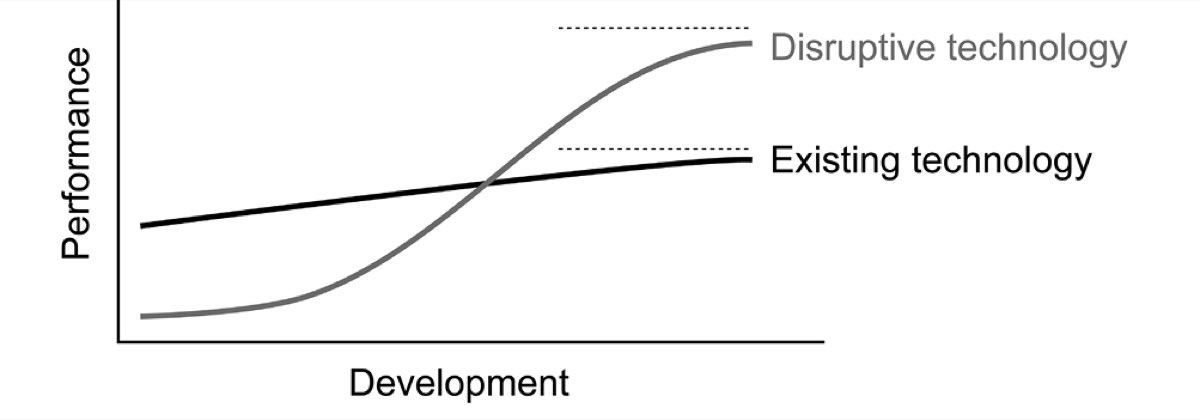
Figure 4. Disruptive technology and ceilings. Disruptive technology may not initially perform better than existing forms, but after enough development—iterations to improve upon it—the disruptive technology exceeds and replaces the existing one. All technology has limits, indicated here by the dotted lines. The ceiling for the disruptive technology must be higher than the one for the existing technology.
If all technology is provisional, there must be a reason for that. I assert that all technology has a ceiling. The ceiling is the best that a current technology can conceivably become at solving problems before another disruptive technology of an entirely new design or paradigm is needed. This is equivalent to the notion that all knowledge has a limit. Consider a horse-drawn carriage, used to transport people and goods for the majority of human history. In fact, before the advent of automotive and locomotive technology in the 19th century, humans and animals were the only technology to physically move goods on land—prime movers—as author Vaclav Smil labels them and highlights in much of his work.13 Trains developed before automobiles, and still animal carriages were needed for local, last-mile transport. Clearly, animals as prime movers have limiting factors: they need to be fed, to sleep, and require training through coercion. Moreover, they are limited in how much horsepower they can provide. None of these limitations applied to trains and automobiles. Once those technologies reached sufficient fruition, the technology of animals as prime movers waned. We will discuss the limits of animals as a food technology in Chapter 4.
How do we generate new technologies that will disrupt old ones? Just like knowledge generation, this requires conjectures. I do not have a good theory for how this works comprehensively. If I did have an actionable theory, I would be a rich man. I offer instead a few thoughts. It’s clear that humans have a particular ability to assimilate observations, process our surroundings, and make conjectures. According to the philosopher Daniel Dennett and his theory of consciousness of Multiple Drafts, our conscious perceptions fundamentally work by making conjectures about situations and applying evidence to refute them.14 This is one reason why different people can have completely different perspectives on the same situation. This consciousness modus also explains hallucinations and mirages, situations that occur when the evidence fails to dispel the perception. Curiously, we are always employing the same knowledge generation process posed by Popper. We are natural innovators. A mechanistic biological understanding behind this process is still insufficient. Otherwise, we might be able to program an artificial intelligence that would be conjecturing and refuting, and presumably in a more facile manner than humans. For now, we humans are particularly capable of generating knowledge and technology as a direct outgrowth of our conscious makeup.
Additionally, all explanatory knowledge has reach, also posited by David Deutsch.15 If we have knowledge that is explanatory, that is, if we can state the underlying elements, the specific interactions, and expected outcome, then that knowledge reaches to other domains. For example, with Newton’s Laws, such as force equaling mass multiplied by acceleration, we could apply this knowledge to civil engineering in order to construct buildings. In fact, we can think of all engineering as simply extending the reach of other more “fundamental” knowledge, often in unexpected ways. The study of particle physics theory led to the development of the Positron Emission Tomography scanner to detect cancer. The best biological engineering tool, CRISPR-Cas9, was developed from the study of bacterial immune systems. It may be used to create all of our meat in the coming years.
In Appendix A, I discuss how the lack of predictability in future knowledge leads to the lack of predictability in our future generally. The property of reach plays into this. Sometimes the reach will not even be immediately apparent. Fundamental scientific techniques in nanotechnology, for example, did not receive much attention until nearly fifty years after initial publication.16 The advent of new microscopy and imaging methods facilitated a resurgent interest in them. Generally, we cannot forecast how new knowledge ripples through our lives, and the property of reach only complicates this notion further.
Technological progress in certain areas seems to occur much more quickly than in other areas. I remember how rapidly computers seemed to improve in the late nineties and early aughts. I remember how anxious I was about buying a computer for high school. I knew that I would have to bite the bullet of buyer’s remorse at some point. The laptop my parents bought me would be obsolete within a year. I could have saved all of the Best Buy mailing flyers and created a flip book showing a physical manifestation of Moore’s Law—the number of transistors per area (density) doubling every two years. Compared to other areas such as biotechnology and nutrition, computer hardware innovation, particularly in data storage capacity and processor speed, demonstratively occurred faster.
I term the degree of difficulty of knowledge generation as tractability. A tractable problem is one that can be readily solved with modest knowledge generation. For example, suppose that I need to calculate how many apples I would have to buy in order to have one for each day of the week. Assuming that I go to the grocery store once per week, I can calculate that I need to buy seven apples during that excursion. The problem is so tractable that I don’t even have to ponder it deeply; immediately, my brain conjures the number seven. Tractability of problems also directly relates to the existing knowledge/technology that we already have available. For example, suppose I need to measure the protein content of a certain food. Three hundred years ago, this would have been impossible even if we had understood what proteins were back then. Now, there are a bevy of instruments and biochemical assays one can perform. Today, even the most modest biochemistry lab will have the capability to measure protein content, however roughly.
Problems clearly vary in how tractable they are. We can take this a step further and consider the substrate itself and the problems surrounding it. Perhaps the most studied substrate in existence is the human body. We are clearly vested in the human body (a normal Joe might just call it obsessed with our own health) as exemplified by the resources we allocate to medical research—over $250 billion in 2012 worldwide.17 We clearly seek to improve the functioning of the human body as much as possible: to make it live longer, work more efficiently, and, when systems fail, more easily fix them. However, if one compares a human body to an object like a car, differences emerge. We’ve been able to iterate cars so that they last longer, are less polluting, and are safer—at a fraction of the innovation cost (around $50-60 billion in 201218) that we’ve spent on humans. It is safe to call cars a more tractable substrate than humans. How tractable a substrate is will suggest how readily we can iterate or improve it in the knowledge generation apparatus.
Lastly, we allocate a different amount of resources to different problems. Resources may take the form of people working on the problem, the money that we invest to do that work, or even the computers running simulations in order to generate more knowledge related to the problem. Collectively, I call this bandwidth: the resources that we apply to a problem in order to generate more knowledge. How we allocate bandwidth as a society depends on a mixture of current problems and values. For example, during World War II, the US had trouble accessing natural rubber due to the Japanese occupation throughout the Pacific Theater (where that resource was produced), specifically in Indonesia.19 The United States made a concerted effort to discover synthetic sources of rubber and invested heavily in petrochemical research. As a result, and with partnership with Dow Chemicals, the synthetic rubber industry was born and rapidly burgeoned. In fact, today, we mostly use synthetic rubber in place of natural rubber. Also, during World War II, the US shifted bandwidth toward the development of nuclear arms. And hence, the atomic bomb was created. Both problems were clearly tractable but lacked the requisite bandwidth to solve the problems until they became prioritized.
I find that most laypeople with whom I discuss scientific development see bandwidth as the primary limitation to knowledge generation. That is, the only reason we haven’t made substantial scientific developments in certain spaces is because we do not apply any or enough resources to these problem areas. I disagree with this sentiment. Yes, the tractability of the problems absolutely matters. We haven’t cured cancer because it’s a difficult, intractable problem. We pour tons of resources into this pursuit; the US National Institute of Health spends over $5 billion per year,20 pharmaceutical companies invest almost ten times more.21 Collectively, a substantial amount of bandwidth is spent on cancer research. While we’ve made progress in this area, it is trifling compared to the magnitude of resources that have been invested. Many researchers have concluded that we would achieve better returns elsewhere.22 I do not disparage those who have put forth such a Herculean effort. I see it more that cancer is a particularly intractable problem owing to a multitude of factors such as the mechanistic differences between different cancers, the localization of drugs and treatment, and the detection and diagnosis of the disease.
In contrast to cancer research, I assert that there exists a subset of problems that are tractable with modest bandwidth. From the title of the book, you’ll be able to glean one of those problem areas. Replacing animals should be a relatively tractable task, as I will discuss in Chapter 5, but we have allocated a pittance in terms of bandwidth (see Chapter 9); accordingly, we are still availing ourselves of inferior animal technology. The next section of the book delves into the details behind current animal technology and why it is so ripe for disruption. Animal technology has a low ceiling.
I have also delivered a summary of what I find to be the best model for knowledge/technology generation. This foundation for humanity’s knowledge generation enterprise will constrain and inform the rest of the book. Because of the amount of preliminary information, I leave Table 1 as reference to the aforementioned concepts. Note that the term “Pareto frontier” will be discussed in depth in Chapter 4.
Chapter Terms
- epistemology: the philosophy behind knowledge and what we know
- phenotype: a measurable or observable biological trait
- conjectures: a putative or durable knowledge
- refutations: data, experiment results, or an argument that can falsify a conjecture in comparison to a competing conjecture
- knowledge/technology: anything that solves problems or answers a question
- ceiling: the limit of a technology
- bandwidth: the amount of resources allocated to solving a problem
- consciousness: the act of repeatedly conjecturing a perception of a situation, falsified by encountered evidence
- reach: the property of explanatory technology to extend to unforeseen niches or problems
- tractability: how easy it is to develop knowledge or technology in a market, problem area, or around a substrate (e.g. human bodies or cars)
- disruptive: a new technology that displaces or can displace an existing technology
- nucleate: beginning a new technology
Table 1. Knowledge in many forms.
| Term in epistemology | Term in technology | Term in biology | Description | Examples |
|---|---|---|---|---|
| Knowledge | Technology | Species or library | Anything that can be subjected to Popperian model: solves problems and can be refuted. Can also be iterated. | Theory of Evolution, Newton’s Laws, a vacuum cleaner, a computer algorithm |
| Conjecture | Formulation of a technology | A variant of a species | An entity attempting to solve a problem or survive/reproduce in a niche | A new theory, Theory of Evolution, prototype vacuum cleaner, established vacuum cleaner |
| Refutation | Selection pressure | A force that favors a subpopulation of conjectures or variants based on some trait | An experimental measurement that favors one theory versus the others. A carbon tax. | |
| Iteration | Iteration | Generation, round, or iteration | Creating variation on a piece of knowledge and technology, then applying refutations, in order to try to solve more problems | Theory of Evolution with epigenetics. Better cars, better computers, better phones. |
| Limit | Ceiling | Pareto frontier | Absolute coverage of problems a knowledge or technology can solve before needing replacement | Theory of Evolution can explain how species change over time but cannot explain the origin of life. Vacuum cleaners cannot find me a job. |
| Problem | Problem or market (in economics sense) | Niche | Whatever issue or question we deem worth solving. Something that knowledge or technology can be applied toward. | Starvation, disease, dirty carpets, how do species change over time? |
| Nucleation | Nucleation | Speciation | Incepting a new type of knowledge or technology to solve problems | Isaac Newton formulating calculus. Darwin formulating the Theory of Evolution. First prototype cars and phones. |
| Tractability | Tractability | Variation and speciation capability | How difficult solving a set of problems is. How difficult it is to nucleate/iterate a given knowledge or technology. | Cancer is a much more intractable problem versus developing synthetic rubber. The human body is a much more intractable substrate compared to cars. |
| Bandwidth | Bandwidth | Number of entities within the species or library | The amount of resources allocated to solve a problem | Academic research funding. Venture capital funding. Number of people working in a given area. |
Chapter Summary
The generation of knowledge/technology will determine how quickly we can replace animal products. First, we must understand how new knowledge/technology forms, and can leverage Karl Popper’s evolutionary model, the best-known knowledge-generation model to date. Knowledge and technology are developed through the process of conjectures, positing a putative idea or invention. We try to refute the knowledge, and the most “fit” knowledge endures. We can nucleate new technology and iterate through conjectures/refutations until we reach the ceiling. Once the ceiling is reached, we must find technologies of entirely new designs for the specific problem/niche.
Footnotes
-
Rodríguez-Bravo, B., Nicholas, D., Herman, E., Boukacem-Zeghmouri, C., Watkinson, A., Xu, J., … Świgoń, M. (2017). Peer review: The experience and views of early career researchers. Learned Publishing, 30(4), 269–277. https://doi.org/10.1002/leap.1111. ↩
-
Popper, K. (2002). Conjectures and Refutations: The Growth of Scientific Knowledge. 2nd edition. London ; New York: Routledge. ↩
-
Gibbs, J. W. (1961). The Scientific Papers of J.Willard Gibbs, Vol. 1: Thermodynamics. Dover Publications. ↩
-
Yehuda, R., Daskalakis, N. P., Bierer, L. M., Bader, H. N., Klengel, T., Holsboer, F., & Binder, E. B. (2016). Holocaust Exposure Induced Intergenerational Effects on FKBP5 Methylation. Biological Psychiatry, 80(5), 372–380. https://doi.org/10.1016/j.biopsych.2015.08.005. ↩
-
ArXiv.Org e-Print Archive. https://arxiv.org/ (Accessed November 28, 2020). ↩
-
ChemRxiv: The Preprint Server for Chemistry - Browse. https://chemrxiv.org/ (Accessed November 28, 2020). ↩
-
MedRxiv.Org - the Preprint Server for Health Sciences. https://www.medrxiv.org/ (Accessed November 28, 2020). ↩
-
BioRxiv.Org - the Preprint Server for Biology. https://www.biorxiv.org/ (Accessed November 28, 2020). ↩
-
Flier, J. S. (2020). Covid-19 Is Reshaping the World of Bioscience Publishing. STAT. https://www.statnews.com/2020/03/23/bioscience-publishing-reshaped-covid-19/ (Accessed November 28, 2020). ↩
-
Kodvanj, I., Homolak, J., Virag, D., Trkulja, V., & Trkulja, V. (2020). Publishing of COVID-19 Preprints in Peer-reviewed Journals, Preprinting Trends, Public Discussion and Quality Issues. BioRxiv. https://doi.org/https://doi.org/10.1101/2020.11.23.394577. ↩
-
Deutsch, D. (2012). The Beginning of Infinity: Explanations That Transform the World. Reprint edition. New York NY Toronto London: Penguin Books. ↩
-
Carreyrou, J. (2018). Bad Blood: Secrets and Lies in a Silicon Valley Startup. 1 edition. New York: Knopf. ↩
-
Smil, V. (2005). Creating the Twentieth Century: Technical Innovations of 1867-1914 and Their Lasting Impact. 1 edition. Oxford; New York: Oxford University Press. ↩
-
Dennett, D. C. (1992). Consciousness Explained. 1 edition. Boston: Back Bay Books. ↩
-
Deutsch, David. (2012). The Beginning of Infinity: Explanations That Transform the World. Reprint edition. New York NY Toronto London: Penguin Books. ↩
-
Ke, Q., Ferrara, E., Radicchi, F., & Flammini, A. (2015). Defining and identifying Sleeping Beauties in science. Proceedings of the National Academy of Sciences of the United States of America, 112(24), 7426–7431. https://doi.org/10.1073/pnas.1424329112. ↩
-
Chakma, J., Sun, G. H., Steinberg, J. D., Sammut, S. M., & Jagsi, R. (2014). Asia’s Ascent — Global Trends in Biomedical R&D Expenditures. New England Journal of Medicine, 370(1), 3–6. https://doi.org/10.1056/NEJMp1311068. ↩
-
Projected global automotive research and development expenses between 2012 and 2020. Statista. https://www.statista.com/statistics/373853/global-automotive-research-and-development-spending/ (Accessed December 26, 2019). ↩
-
Darby, Kenyatta, and Matthew World War II Rubber Crisis/ Invention of Synthetic Rubber. The History Of Rubber. http://historyofrubber.weebly.com/wwii.html (Accessed December 26, 2019). ↩
-
Estimates of Funding for Various Research, Condition, and Disease Categories (RCDC). https://report.nih.gov/categorical_spending.aspx (Accessed December 26, 2019). ↩
-
IFPMA. (2017). THE PHARMACEUTICAL INDUSTRY AND GLOBAL HEALTH FACTS AND FIGURES 2017. International Federation of Pharmacutical Manufacturers & Associations, 86. https://www.ifpma.org/wp-content/uploads/2017/02/IFPMA-Facts-And-Figures-2017.pdf. ↩
-
Holden. (2014). Returns to Life Sciences Funding. The GiveWell Blog. https://blog.givewell.org/2014/01/15/returns-to-life-sciences-funding/ (Accessed December 26, 2019). ↩
Text licensed CC BY 4.0; figures excluded — see the license.